DigiSam Partners with Academic Researchers to Build AI Solutions for Rural Communities
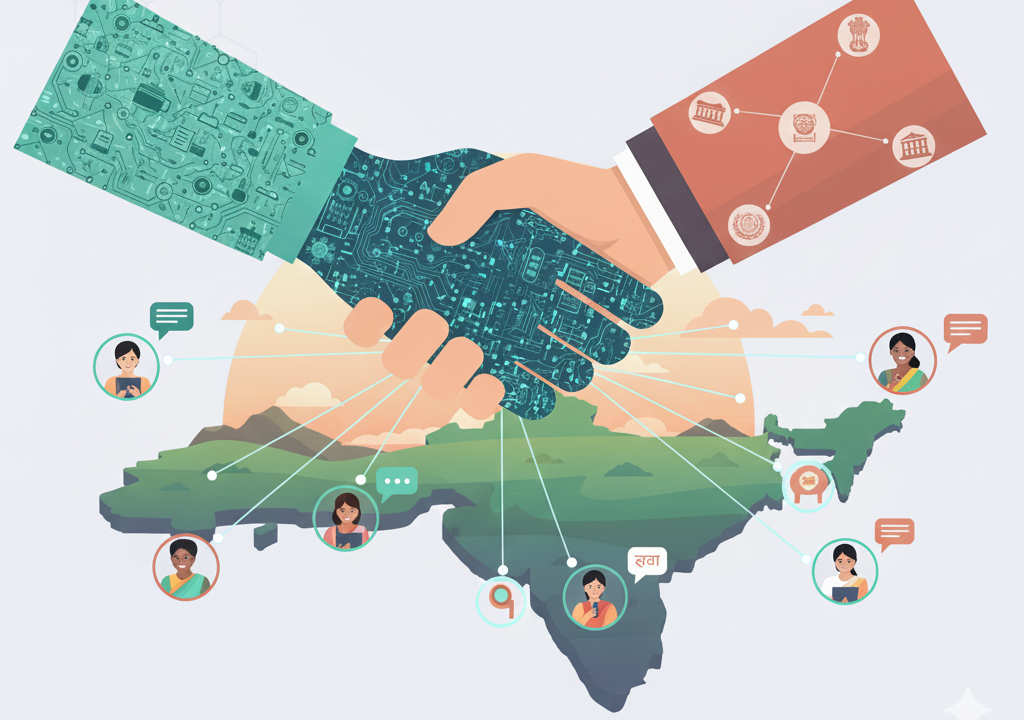
In an exciting collaboration, DigiSam Foundation is partnering with Professor Amol Sharma and his team of computer science students to develop an agentic marketplace for last-mile delivery of government services—powered by insights from our Survey Sakhi data.
DigiSam Foundation is thrilled to announce a groundbreaking academic partnership with Professor Amol Sharma and his talented computer science students. Together, we're embarking on an ambitious project to build AI-driven solutions that address the digital literacy gaps identified through our Survey Sakhi research.
From Data to Innovation
The Survey Sakhi project revealed that rural women face significant barriers in accessing government services online—not due to lack of awareness, but due to the complexity of digital interfaces and lack of guidance. Our data showed that 85% of women cannot access government schemes digitally, despite knowing about programs like widow pension, Ujjwala gas, and Jan Dhan accounts.
This insight sparked a question: What if technology itself could bridge this gap? What if AI could simplify the process of accessing government services, making it as easy as having a conversation?
The Agentic Solution for Last-Mile Service Delivery
Working closely with Professor Amol Sharma and his dedicated team of students, we're developing an agentic marketplace for last-mile delivery of government services. This innovative platform will use AI agents to help rural citizens navigate complex government portals, understand eligibility criteria, and complete applications—all in their local language and through intuitive interfaces.
The agentic approach means the system acts autonomously on behalf of users, intelligently handling the complex workflows required to access government schemes. Rather than simply providing information, the AI agents actively guide users through each step, adapting to their needs and circumstances.
The system is being designed based directly on the barriers and preferences documented during Survey Sakhi. For example, knowing that 98% of women prefer group learning, the platform will include community access points where women can use the system together with peer support.
Academic Partnership for Social Impact
This partnership represents the best of academia meeting grassroots social work. Professor Amol Sharma and his computer science students are gaining real-world experience building technology for social good, while DigiSam gains access to cutting-edge AI expertise and development resources.
For Professor Sharma's team, this project offers something textbooks cannot: the opportunity to see their code make a tangible difference in people's lives. They're not just building an app—they're solving a real problem that affects millions of rural Indians, working on cutting-edge agentic AI solutions that could transform how government services reach the last mile.
Evidence-Based Technology Design
What makes this project unique is its foundation in community research. Rather than assuming what rural women need, we're building solutions based on what 164 households told us during Survey Sakhi. This evidence-based approach ensures that the technology we develop actually addresses the barriers that exist—not the barriers we imagine.
The Survey Sakhi data is informing everything from language choices to interface design to the types of government services we prioritize in the initial rollout. Every design decision is backed by real user insights from our community research.
Project Timeline and Development
The project is currently in the planning and design phase. Professor Amol Sharma and his team are conducting technical feasibility studies and developing the core agentic framework, while DigiSam is working on community partnership development in Saidbhar village. We anticipate a pilot rollout in the coming months, with initial testing focused on a small group of women who participated in Survey Sakhi.
This measured approach allows us to iterate based on user feedback before scaling the solution more broadly. The students are working on sophisticated AI agent architectures that can handle the complexity of government service workflows while remaining accessible to users with limited digital literacy.
Gratitude to Our Academic Partners
We extend our sincere gratitude to Professor Amol Sharma and the dedicated computer science students who are contributing their time, talent, and expertise to this project. Their willingness to apply their technical skills toward social impact—particularly in developing advanced agentic solutions for last-mile service delivery—demonstrates the power of academic collaboration in driving meaningful change.
This partnership exemplifies what's possible when research, technology, and community engagement come together. The combination of Professor Sharma's technical expertise, the students' development skills, and DigiSam's community insights creates a powerful foundation for innovation that truly serves those who need it most.
Stay tuned for updates as we move from planning to pilot to full implementation. This is innovation driven by data, built by dedicated students and researchers, and designed for the communities that need it most. The agentic solution being developed represents a new frontier in bridging the digital divide for government service delivery.
Want to Make a Difference?
Stories like this are possible because of supporters like you. Join us in bridging the digital divide.